
The condition is called Attendance payout method. You find it under Shift & Position conditions in wagelists and pricelists.
Contract and payout method
-
Contract: the agreement the staff member signed with your agency. It is saved in their profile. A staff member can have more valid contracts at the same time, for example an employee contract and a contractor contract.
- Payout method: the type of employment relationship used for one attendance. Each payout method is connected to a contract in Settings > Finances > Payout methods.
The contracts say under which relationships the staff member can work. The payout method says under which one they work on this shift.
How it works
The system checks the payout method set on the attendance. You can choose from the payout methods your agency has in Settings > Finances > Payout methods.
- = the attendance is paid with this payout method.
- ≠ the attendance is paid with any other payout method.
The condition checks the payout method of the attendance, not the contracts in the staff member's profile.
If the attendance has no payout method, the condition is not met.
If you change the payout method of an attendance, the rate is calculated again.
Payout method or Contract condition?
-
Use the Attendance payout method condition when the rate depends on how this one attendance is paid.
- Use the Contract condition (in Staff conditions) when the rate depends on which contracts the staff member has. It looks at all their valid contracts, not at the one used for the shift.
Example
Contractors get a higher hourly rate.
- Rule 1: Attendance payout method = Contractor → €22 per hour, Worked hours.
- Else rule: Always apply → €20 per hour, Worked hours.
Result: Attendances paid as Contractor get €22 per hour. All other attendances get €20 per hour. 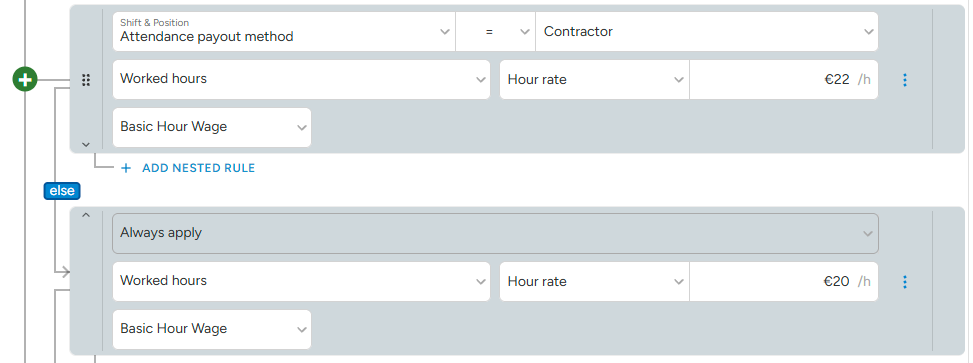
When you test this rule in the Calculator, choose the payout method in the calculator form.